人马座传来的神秘宇宙电波 ,困扰人类半个世纪的 "哇 " 信号


Unexplained Mysteries

BACKDROP
The Wow! Signal

背景介绍:
1959 年,物理学家提出可以通过宇宙无线电波搜寻地外智慧生命,建议把宇宙中最常见的氢元素 1420 兆赫作为监听频段。
美国俄亥俄州的 “大耳朵(Big Ear)” 射电望远镜,依靠地球自转扫描星空,1973 年开启地外文明(SETI)搜寻工作。望远镜不能转动追踪目标,天体信号扫过设备波束大约持续 72 秒。

事件简介:
1977 年 8 月 15 日,大耳朵望远镜扫描人马座时捕捉到一道强烈窄频信号,频段接近氢的特征频率,强度变化曲线刚好 72 秒,符合遥远天体经过波束的特征。
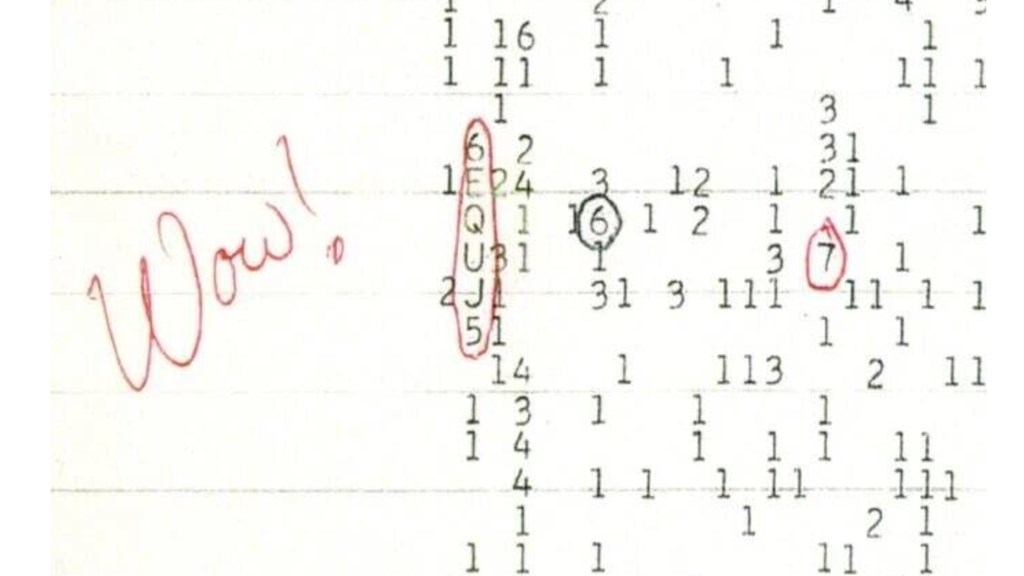
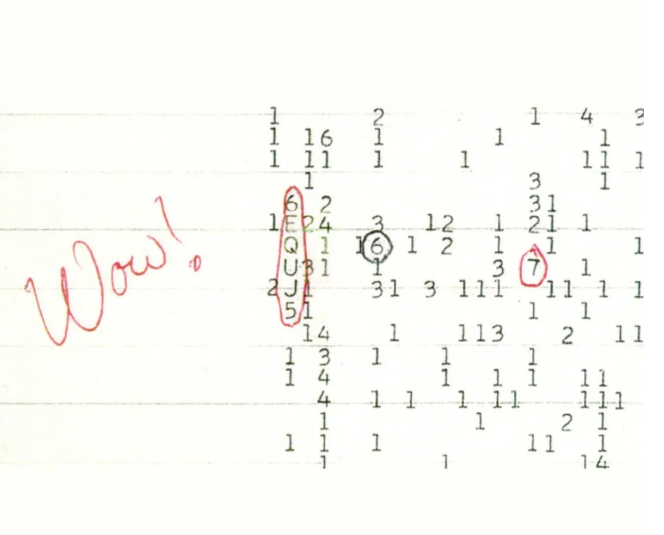
几天后志愿者天文学家杰瑞・埃赫曼处理打印数据,看到编码6EQUJ5,用红笔圈出并在边上手写 “Wow!”,事件由此得名。该信号只被望远镜其中一个接收喇叭捕捉到,没有重复出现;后续多次重扫该片天空,再也没有捕捉到相同信号。
科学界提出多种猜想:外星文明发射的信号、彗星、地面 / 人造物体干扰、星际冷氢云被磁星辐射短暂增亮等,但全部都没有得到证实。大耳朵望远镜 1998 年被拆除,唯有那张写有 Wow! 的打印纸质档案留存至今,哇!信号依旧是未解之谜。
Ep/29

MYSTERIES
Unexplained Mysteries
with Anlan
Welcome to a world of secrets and unanswered questions—a world of true mysteries that no one has ever solved. Today, we are going on a journey into the strange and the unexplained.
Are you ready to explore the unknown? Let's begin.

🎵
🔺点击收听音频
On a quiet August night in 1977, in the countryside of Ohio, a giant radio telescope stood beneath the stars. Its name was Big Ear. It did not have the enormous movable dish that most people imagine. Instead, two vast reflectors stood across an aluminium-covered field, gathering faint radio waves as the Earth slowly turned.
A few days later, volunteer astronomer Jerry Ehman sat with a stack of computer printouts, checking the data by hand. Suddenly, he stopped. In the middle of a page was a sequence of numbers and letters: 6EQUJ5.
Among rows of ordinary readings, these six characters recorded something remarkable. Ehman picked up a red pen, circled them, and wrote one word in the margin: “Wow!”
That single word gave the event its name. Nearly fifty years later, the Wow! Signal remains an unsolved mystery in the search for life beyond Earth.
To understand why it caused such excitement, we need to go back to 1959.
That year, two physicists proposed a way to search for intelligent life among the stars. Radio waves can travel enormous distances through space. If another civilisation wanted to attract attention, a radio transmission might be a practical choice.
But where should we listen? The radio spectrum is vast. Searching without a plan would be like trying to find one particular voice among millions of conversations.
The physicists suggested a natural meeting point: the radio frequency of hydrogen, the most common element in the universe. At about 1420 megahertz, it would be familiar to any civilisation that studied the sky. Perhaps other astronomers, on another planet, would choose it too.
Originally built to survey radio sources, Big Ear began a dedicated search for extraterrestrial intelligence, or SETI, in 1973.
The telescope could not turn to follow an object. It relied on the Earth's rotation to carry different regions of sky through its beams. A steady radio source would appear to grow stronger as it approached the centre of a beam, then weaken as it moved away. That passage would take approximately seventy-two seconds.
On 15 August 1977, Big Ear was scanning the constellation Sagittarius when an unusually strong signal entered its receiver.
It occupied just one narrow frequency channel, close to the hydrogen frequency. Its strength rose, reached a peak, and fell away. The six readings covered seventy-two seconds, matching the pattern expected from a distant source passing through the beam.
The observation happened automatically. There was no dramatic moment in which an astronomer heard the signal and called everyone into the room. By the time Ehman recognised its importance, the telescope had already moved on through its survey. The discovery arrived as ink on paper, days after the event itself. That delay left the team trying to investigate something that had already slipped beyond their brief window of observation.
No one heard a voice or a series of mysterious musical notes. The telescope recorded measurements, which appeared on paper as numbers and letters.
Those characters, 6EQUJ5, were not an alien message. They were a code describing the signal's changing strength. Each represented a measurement taken at twelve-second intervals. The letter U marked the peak: an exceptionally strong reading compared with the usual fluctuations in background noise.
The timing was striking, but it did not tell scientists how long the source itself had been transmitting. Big Ear could only observe that part of the sky briefly before the Earth's rotation carried it out of view.
There was another puzzle. The telescope had two receiving horns, which observed the same region a few minutes apart. A continuous source should normally have appeared twice. This signal appeared in only one.
Whatever had produced it, something about the event was unusual.
Researchers searched the region again. Later observations with other telescopes also failed to recover the signal. Without a second detection, they had little opportunity to test competing explanations.
The most exciting possibility was a transmission from another civilisation. Its narrow frequency range and rise and fall were consistent with something SETI researchers hoped to find.
But consistency is not proof. Nothing in the record established that an intelligent being had sent it. And if it was a beacon intended to attract attention, why had it appeared only once? Perhaps a transmitter had switched off or its beam had swept past Earth. These were possibilities, not answers.
Others looked for a natural source.
One proposal involved comets. As a comet approaches the Sun, it can develop a surrounding cloud containing hydrogen. Could such a cloud have produced the radio signal?
The suggestion attracted attention in 2017, but it faced serious objections. Researchers questioned the comets' positions and whether they could generate a signal with the required properties. It did not become an accepted explanation.
Then there was interference from Earth. Could a satellite, space debris, or a reflected human transmission have fooled the telescope?
The observing frequency lay within a band protected for radio astronomy, where transmitters were not supposed to operate. The signal's shape also fitted a source crossing the telescope's beam. These details made ordinary interference harder to explain, but they could not rule out every possible human source.
In 2024, researchers studying archived observations proposed another explanation: a cloud of cold hydrogen between the stars.
Such clouds normally produce faint radio emissions. The researchers suggested that a powerful burst of radiation, perhaps from a highly magnetic star called a magnetar, could briefly make a cloud much brighter. That might create a strong, narrow signal without any alien transmitter.
A follow-up analysis in 2025 proposed revisions to the Wow! Signal's estimated strength, position, and frequency. However, the proposed brightening mechanism remained unproven. The researchers had not demonstrated that this was what Big Ear detected in 1977.
The difficulty is that each explanation must account for the same small collection of evidence: a narrow frequency range, a distinctive rise and fall, and a detection in only one beam.
There is no recording to replay for hidden words. There is no confirmed repeat that another observatory can examine. Scientists have measurements from a brief observation and a sky that has offered no clear repeat performance.
Big Ear itself is gone. The telescope was dismantled in 1998. Yet the printout survives: rows of characters, a red circle, and a handwritten reaction that needs no scientific training to understand.
Its power comes from the contrast between the ordinary page and the extraordinary possibility it raised. Someone built an instrument to listen. Someone patiently checked its results. And something appeared that they could not explain.
Whether it came from unfamiliar natural activity, human interference, or another civilisation, the record does not tell us.
For now, the most honest ending is still the one Jerry Ehman left on the page: a circle around six characters, and a single word of surprise.
排版长图:
责编/校对:
图片来源:
Jer.ry
Jenny
均来源于网络 | 侵删







▲点击以上图片,Get世界精选好物


