一个外国人把埃菲尔铁塔卖了两次 !剧本都写不出比这更炸裂的事情 ...

铺 子

▲点击进入 相应板块
Unexplained Mysteries

BACKDROP
The Man Who
Sold the Eiffel Tower

背景介绍:
事件发生于 1925 年的法国巴黎,埃菲尔铁塔原本为 1889 年世博会修建,原定 20 年后拆除。 铁塔因无线电通信用途得以保留,但数千吨铁质结构的维护除锈需要承担高昂开销。
维克多・拉斯蒂格是 20 世纪早期知名诈骗分子,本人真实身世史料难以核实。他掌握多国语言,擅长伪造多重身份,曾在欧洲、美洲多地实施各类诈骗犯罪。他阅读报纸上关于铁塔维护成本过高的报道,由此萌生售卖埃菲尔铁塔的诈骗计划。
事件简介:
拉斯蒂格伪装成法国邮电部高级官员,使用仿官方文书,在高级酒店召集巴黎废金属商人开展秘密竞标。
他对外谎称政府计划秘密拆除埃菲尔铁塔变卖废铁,还带领商人实地考察铁塔,强化骗局可信度。商人普瓦松迫切想要拿下该项目,拉斯蒂格借机索要贿赂,骗取巨额资金后逃往维也纳。受害者因为自身参与行贿,害怕公开蒙羞,选择不报警;拉斯蒂格再度返回巴黎二次行骗,遭人怀疑后逃离法国。
拉斯蒂格后续在美国继续实施犯罪,因伪造货币被捕入狱,1947 年在医疗机构病逝;这场骗局的本质,是骗取当事人对虚假机会的信任。
Ep/24
MYSTERIES
Unexplained Mysteries
with Anlan
Welcome to a world of secrets and unanswered questions—a world of true mysteries that no one has ever solved. Today, we are going on a journey into the strange and the unexplained.
Are you ready to explore the unknown? Let's begin.

🎵
🔺点击收听音频
It is Paris, 1925.
The city was enjoying a warm spring. Elegant cars moved along wide boulevards. Well-dressed crowds filled cafés, and fashionable hotels welcomed wealthy guests from across Europe.
Above them all stood the Eiffel Tower.
Today, it is impossible to imagine Paris without it. The iron structure appears on postcards, films, key rings and millions of holiday photographs. It is one of the most recognisable buildings in the world.
But in 1925, not everyone loved it.
The tower had been built for the Paris World’s Fair of 1889. It was supposed to demonstrate French engineering and industrial power. At more than three hundred metres tall, it was unlike anything the world had seen.
Many artists and writers hated it. They thought the enormous iron structure was ugly and completely unsuitable for a beautiful historic city.
The tower was originally expected to remain for only twenty years. However, its height made it useful for radio communication, so it was saved from demolition.
By the 1920s, it was still standing—but maintaining thousands of tonnes of iron was expensive. The tower required regular repairs and repainting to protect it from rust.
And somewhere in Paris, a man called Victor Lustig read a newspaper article discussing these problems.
As he read, an extraordinary thought entered his mind.
He was going to sell the Eiffel Tower.
There was only one small difficulty.
It did not belong to him.
Victor Lustig was one of the most successful confidence tricksters of the early twentieth century. Even his real identity is uncertain.
He claimed that he had been born in 1890 in a town then belonging to Austria-Hungary and now located in the Czech Republic. Sometimes he described himself as the son of an important local family. At other times, he said his parents had been poor farmers.
Historians have struggled to confirm even these basic details.
This uncertainty was appropriate because Victor Lustig spent his life becoming other people.
He used dozens of false names and carried several passports. He spoke multiple languages and could present himself as an aristocrat, businessman, banker or government official.
One of his favourite identities was “Count Victor Lustig.”
There is no evidence that he was really a count. But he dressed carefully, spoke quietly and behaved as people expected a European aristocrat to behave.
Lustig understood an important principle: people often believe what they expect to see.
If he had entered a luxury hotel wearing dirty clothes and shouting about an exciting opportunity, people would probably have called security.
Instead, he appeared calm, serious and slightly distant. He did not desperately ask people to trust him. He behaved as if his importance should have been obvious.
Before arriving in Paris, Lustig had already carried out numerous dishonest schemes in Europe and the United States. He often met wealthy travellers aboard ocean liners and persuaded them to invest in imaginary businesses or unusual machines.
But the Eiffel Tower would be his boldest plan.
According to later accounts, the idea came from a genuine newspaper discussion about the tower’s expensive maintenance.
The story did not say that the tower would definitely be demolished. It merely discussed its problems.
For Lustig, however, that was enough.
He began presenting himself as a senior official from the French Ministry of Posts and Telegraphs. He used official-looking stationery and invited several of Paris’s leading scrap-metal dealers to a confidential meeting.
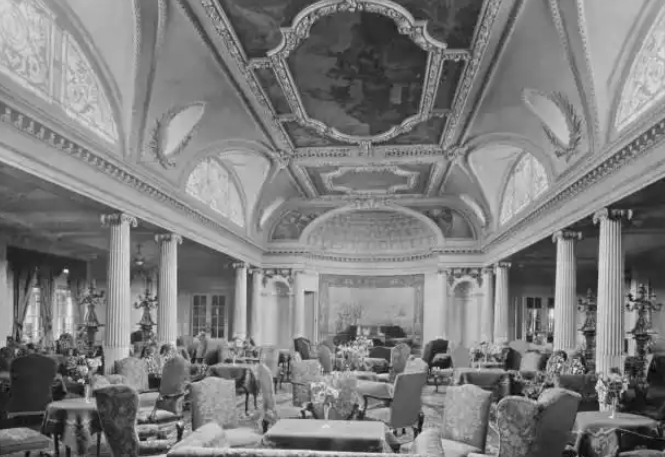
The location was carefully chosen: the Hôtel de Crillon, one of the grandest hotels in Paris.
The building stood on the Place de la Concorde and was filled with marble, chandeliers and expensive furniture. Government ministers, diplomats and aristocrats regularly visited it.
When the businessmen arrived, everything appeared correct. The hotel was impressive. The letters looked official. Their host was perfectly dressed and spoke with confidence.
Lustig explained that they had been invited to discuss a matter of great national importance.
The French government, he said, had decided to demolish the Eiffel Tower.
Its original purpose had ended. Public opinion remained divided, and the cost of maintenance had become too high. The government therefore planned to sell the tower’s metal.
But the decision had to remain secret.
If the public discovered the plan too early, there might be protests. The newspapers would create a political scandal. For this reason, only a small group of respected businessmen had been invited to compete for the contract.
The story sounded extraordinary.
But it did not sound impossible.
The Eiffel Tower contained more than seven thousand tonnes of iron. For a scrap-metal dealer, the right to dismantle and sell that material could produce an enormous profit.
Lustig invited the businessmen to submit private bids.
He then arranged a tour of the tower.
A hired limousine carried the group through central Paris. Lustig sat among the businessmen like a government official supervising an important national project.
When they reached the tower, he showed them around and allowed them to examine the structure. Tourists and workers moved nearby, paying no attention to the group.
For the businessmen, this public setting made the proposal feel more authentic. Surely a criminal would not discuss a fake government contract while standing directly beneath the Eiffel Tower.
But Lustig was not really interested in their technical opinions. He was watching their reactions.
Who appeared ambitious?
Who wanted the contract most?
Who would be easiest to persuade?
His attention settled on a businessman named André Poisson.
Poisson was relatively new to the Paris business world. He wanted to expand his company and establish himself among the city’s most important scrap-metal dealers.
Winning the Eiffel Tower contract could transform his career.
However, Poisson’s wife was suspicious.
Why was the meeting taking place in a hotel instead of a government office? Why was everything so secret? Why had this unknown official chosen her husband?
Poisson began asking questions.
Lustig realised that the deal was in danger. He needed to make his performance more believable.
During a private conversation, Lustig changed his manner. He became less formal and appeared slightly uncomfortable. He suggested that government officials were poorly paid. Awarding such a valuable contract involved great personal responsibility.
The meaning was clear: Lustig wanted an additional private payment.
Strangely, this made Poisson less suspicious.
A request for a dishonest payment seemed believable. Poisson could understand corruption more easily than he could understand extraordinary good luck.
If the official was asking for money, Poisson reasoned, perhaps the official really did control the contract.
Poisson agreed to pay.
Reports suggest that he gave Lustig approximately seventy thousand American dollars, including the price of the supposed contract and the extra private payment. In 1925, this represented a fortune.
In exchange, Poisson received documents giving him the right to demolish the Eiffel Tower.
The documents were worthless.
Shortly afterwards, Lustig boarded a train carrying the money and escaped to Vienna.
There, he watched the French newspapers and waited.
He expected to see headlines about the crime. He imagined that police would circulate his description across Europe. He prepared to disappear under another identity.
But nothing happened.
Day after day, the newspapers remained silent.
André Poisson had realised that he had been tricked. But reporting the crime would mean admitting that he had tried to bribe a government official. It would also reveal that he had paid an enormous sum for a building that was never for sale.
Humiliated and afraid of becoming a public joke, Poisson apparently chose not to contact the police.
His silence protected the man who had robbed him.
When Lustig realised this, he made an astonishing decision.
He returned to Paris and tried to sell the Eiffel Tower again.
He contacted another group of scrap-metal dealers and repeated the story. Once again, he presented himself as a government official responsible for arranging the secret demolition.
This time, however, his chosen buyer became suspicious and contacted the police.
Lustig escaped before he could be arrested and left France. Despite the popular claim that he sold the tower twice, the evidence suggests that his second attempt did not succeed.
Nevertheless, selling it once had been remarkable enough.
Lustig returned to the United States and continued committing fraud under different identities. Eventually, however, he became involved in a large counterfeiting operation.
By 1935, federal agents were searching for him.
When they finally arrested Lustig in New York, they found an unexplained key in his possession. It led them to a locker in the Times Square subway station containing counterfeit banknotes and equipment connected with the operation.
Even then, Lustig was not finished.
While waiting for his trial, he escaped from federal detention in broad daylight. Reports claimed that he pretended to be a worker cleaning the outside of the building while people watched from the street.
He remained free for twenty-seven days before officers captured him in Pittsburgh.
This time, his ability to talk his way out of trouble had reached its limit.
Lustig pleaded guilty and received a total sentence of twenty years—fifteen years for counterfeiting and another five for escaping from custody.
In April 1936, he was sent to Alcatraz, the famous island prison in San Francisco Bay.
The man who had invented dozens of identities was now officially recorded as prisoner number 300. Even there, the authorities were not certain of his real name. His prison documents identified him as Robert V. Miller, which may have been yet another invention.
In 1947, after being transferred to a federal medical centre in Missouri, Lustig died from complications connected with pneumonia.
His death certificate contained one final, unintentionally perfect detail.
Under “occupation,” someone had written: “apprentice salesman.”
In one sense, Victor Lustig never truly sold the Eiffel Tower.
He did not own it. He could not transfer it, remove it or give anyone the legal right to demolish it.
What he sold was a story.
He sold Poisson the belief that a secret opportunity had appeared. He sold him the dream of becoming one of Paris’s most successful businessmen. Most importantly, he persuaded Poisson to ignore his doubts.
That is why this kind of crime is called a confidence trick.
The criminal does not simply take money.
First, he takes someone’s confidence.
Victor Lustig did not need to steal the Eiffel Tower.
He only needed one person to believe that he could sell it.
排版长图:
责编/校对:
图片来源:
Jer.ry
Jenny
均来源于网络 | 侵删







▲点击以上图片,Get世界精选好物


